25 Interesting Eye Facts
It's easy to take our eyes for granted, since we spend all day looking through them, not at them. But there's more to them than meets the... well, eye. These odd orbs hold quite a few secrets that most will be surprised to learn. Below are just a few of the interesting things about eyes that most people don't know.

"As optometrists, we examine eyes every day, yet we're still amazed by how remarkable they are. The human eye is one of the most sophisticated organs in the body, capable of adapting to changing light, focusing in an instant, and working seamlessly with the brain to create the world we see. Many of the facts below surprise even people who have worn glasses or contact lenses their entire lives." Mr John Dreyer, Optometrist Bsc(Hons), MCOPTOM, DipCLP
Amazing Eye Facts
- An eye's pupil can expand by as much as 45% when you look at someone you love
- Only 17% of the eye is visible; the rest is hidden within the eye socket
- The eye can refocus incredibly quickly, almost as fast as it can blink
- The muscles that control your eyes move more than any other muscles in the body. During one hour of reading, the eye muscles will have made 10,000 tiny adjustments
- A single blink takes only about 150 milliseconds
- An eyelash sprouts, grows, sheds, and is replaced over a period of approximately 150 days
Vision & The Brain
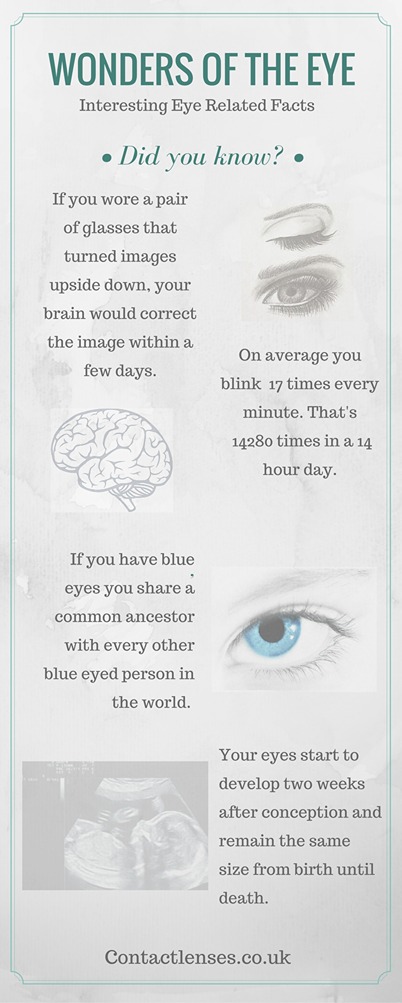
- The images your eyes send to the brain are upside down, but your brain automatically turns them the right way up
- The brain is just as important for vision as the eyes themselves, and some vision disorders actually originate in the brain rather than the eyes
- Primitive eyes first evolved more than half a billion years ago as small patches of light-sensitive cells. No colours or images could be seen, just the ability to detect light and dark
- The first small cells that will eventually develop into eyes appear just 2 weeks after conception
- People who lose their sight later in life may still experience visual images in their dreams.
Colour & Genetics
- Most babies are born with blue eyes, which then change colour as the pigment cells develop over the first few years of life. Some people keep their blue eyes for life.
- Babies have limited colour vision at birth until the light-sensitive cells in the retina fully mature
- Men are around eight times more likely to be colour blind than women
- The retina uses just three types of colour-detecting cells (red, green and blue), and your brain combines their signals to create the millions of colours you see
- Approximately 1 in 50 women have a fourth type of light-sensing cell in their eyes -Tetrachromes - enabling them to see significantly more colours than most people.
- Some people naturally have two different coloured eyes, a condition known as heterochromia

- The famous pirate eye patch wasn't used because they had lost an eye, it was to preserve their night vision. Keeping one eye covered allowed them to maintain night vision. Should they go below deck, where it was dark, they would switch the patch to the other eye to see clearly
- On average, people blink every 5–8 seconds, but when using a computer or digital device, this can drop dramatically to almost 1 minute between blinks, increasing the risk of dry eyes
- Muscles that move the eye tend to twitch and jolt quickly, called saccades, unless they are tracking a moving object, where they then move slowly and steadily
- On a clear day, the human eye can detect objects many miles away. The actual distance depends on the size of the object, atmospheric conditions, and the curvature of the Earth, rather than the eye itself
Everyday Vision
- Shark corneas have been studied as a possible compatible replacement for human corneas, due to their biological similarities
- The blood vessels at the back of the eye are more unique than fingerprints and are increasingly being investigated as a form of biometric identification
- Some eye diseases, including certain forms of eye cancer, affect how light is reflected off the back of the eye. Detection can occur when one eye appears white rather than red in a flash photograph
- Each eye contains more than 100 million cells, but only those in the retina are light-sensitive
Eye Health & Medicine
Wonders Of The Human Eye