
An estimated 160.5 million by 2045!
The most quoted diabetic retinopathy figure in the world is 103 million. It comes from a 2021 analysis in Ophthalmology and its projections were calculated using a diabetes forecast that has since been revised sharply upwards.
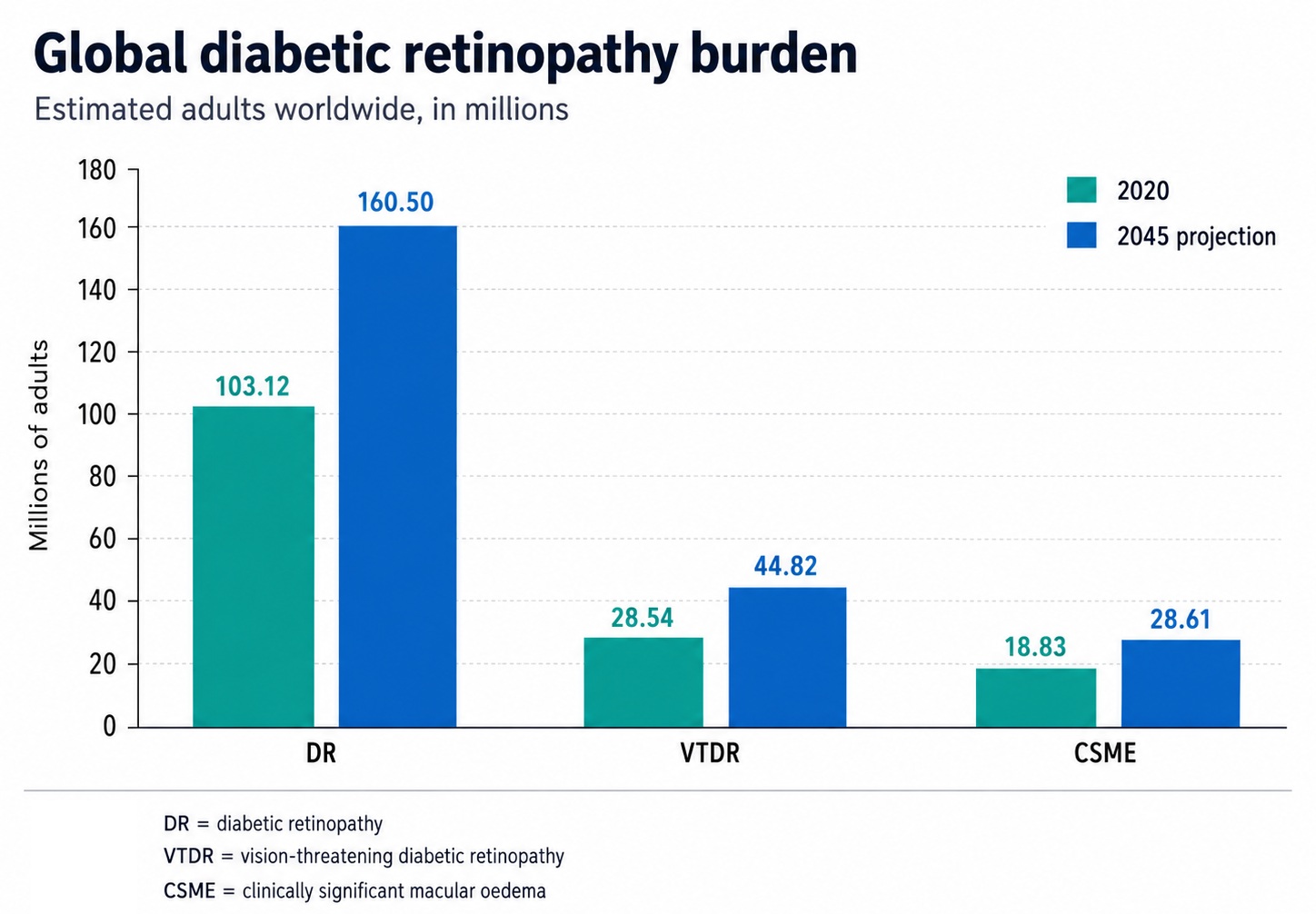
Teo and colleagues estimated 103.12 million adults with diabetic retinopathy in 2020 rising to 160.50 million by 2045. They built those projections on population data from the IDF Diabetes Atlas 2019 which put diabetes at 463 million adults in 2019 and 700 million by 2045.
The IDF published its 11th edition in 2025. Diabetes now stands at 589 million adults aged 20 to 79, with 853 million projected by 2050.
Global figures and where they came from
Among people with diabetes, the 2021 analysis found:
• 22.27% had diabetic retinopathy, 6.17% had vision threatening DR and 4.07% had clinically significant macular oedema
• That gave 103.12 million with DR, 28.54 million with vision threatening DR and 18.83 million with macular oedema in 2020. Projected to become 160.50 million, 44.82 million and 28.61 million respectively by 2045
• Prevalence ran highest in Africa at 35.90% and in North America and the Caribbean at 33.30% and lowest in South and Central America at 13.37%
The diabetes side of the equation from the IDF 11th edition:
• 589 million adults aged 20 to 79 living with diabetes in 2024 or 11.1% of that age group
• 853 million projected by 2050, a 45% rise against 25% population growth
• 252 million, roughly 43% of all cases, are undiagnosed
• Diabetes drove more than USD 1 trillion in health expenditure in 2024
Sight loss is a separate question
Prevalence and blindness get used interchangeably in diabetes content and they differ by roughly two orders of magnitude.
A 2024 analysis in Eye produced by the Vision Loss Expert Group estimated that 1.07 million people were blind from diabetic retinopathy in 2020 with a further 3.28 million experiencing moderate or severe vision impairment.
For working age adults specifically, a Global Burden of Disease analysis found 2.85 million prevalent cases of DR-related vision impairment in 2021 around three times the 1990 figure with South Asia carrying the heaviest regional burden.
United States
The CDC Vision and Eye Health Surveillance System, published in JAMA Ophthalmology, estimated 9.6 million people in the US with diabetic retinopathy in 2021 or 26.43% of those with diabetes. Around 1.84 million had vision-threatening DR at 5.1%.
Two things in that study get overlooked. The number of people aged 40 and over with diabetes-related eye disease more than doubled against the previous 2004 estimate. And it was the first US study to estimate prevalence below age 40: more than one in ten people with diabetes aged 0 to 24 had retinopathy, rising to nearly one in five among 25 to 39 year olds.
United Kingdom
Diabetes UK figures for 2024 / 25 put 4.7 million people in the UK with a diabetes diagnosis, up 155,803 on the previous year, plus an estimated 1.3 million living with undiagnosed type 2. That takes the total past 5 million with a further 6.9 million at increased risk. Diabetes costs the NHS around £10.7 billion, roughly 60% of it on complications. More than 4 million people were registered with the English Diabetic Eye Screening Programme at the end of Q4 2023-24.
The programme has a real achievement behind it. Diabetic retinopathy stopped being the most common cause of blindness certification among working age adults in England and Wales for the first time in five decades, based on certifications in 1999 / 2000 compared against 2009 / 2010. That is the strongest single argument for population screening in UK ophthalmology.
What actually changed in 2026
A review published in February 2026 sets out three changes now working in England. Screen the low risk majority less often so hospital eye services can absorb the high risk minority.
• People with no retinopathy or maculopathy on two consecutive screens move to a two year interval rather than annual
• The R2 grade splits into low risk (R2L) and high risk (R2H) with only R2H referred to hospital
• An OCT surveillance pathway inside the screening programme means only OCT positive maculopathy gets referred
The evidence came from a National Screening Committee audit of nearly 350,000 patients across seven programmes in Britain which found around 0.7% of that group developed referable retinopathy over two years. An R2H grade carries a 45.5% risk of progressing to proliferative retinopathy within five years.
The GLP-1 wildcard
In February this year the MHRA issued a drug safety update noting that semaglutide may very rarely be associated with non arteritic anterior ischaemic optic neuropathy, potentially affecting up to 1 in 10,000 patients. Concern about early worsening of retinopathy after rapid glycaemic improvement has also persisted since the SUSTAIN-6 trial.
On the other hand, an OHDSI network study across 14 databases found no increased risk of proliferative retinopathy or treatment-requiring disease among 810,390 new semaglutide users compared with other agents. Screening in England keeps people starting insulin pumps on annual recall but has no equivalent pathway for those starting GLP-1 receptor agonists.
Eye test
Everyone in England with diabetes aged 12 and over is invited for eye screening and a diabetes diagnosis also entitles you to a free NHS sight test. Screening does not replace a routine eye test. Anyone noticing a change in vision should contact an optometrist rather than waiting for the next invitation.
Sources
https://pubmed.ncbi.nlm.nih.gov/33940045/
https://idf.org/news-and-resources/news/idf-diabetes-atlas-11th-edition/
https://www.ncbi.nlm.nih.gov/books/NBK618744/
https://pubmed.ncbi.nlm.nih.gov/41412135/
https://www.nature.com/articles/s41433-024-03101-5
https://www.ncbi.nlm.nih.gov/pmc/articles/PMC12259346/
https://preventblindness.org/prevalence-of-diabetic-retinopathy-vehss/
https://www.healthdata.org/research-analysis/library/prevalence-diabetic-retinopathy-us-2021
https://www.diabetes.org.uk/about-us/about-the-charity/our-strategy/statistics
https://www.nature.com/articles/s44440-026-00014-y
https://www.ncbi.nlm.nih.gov/pmc/articles/PMC10715554/
https://pubmed.ncbi.nlm.nih.gov/24525390/
https://pmc.ncbi.nlm.nih.gov/articles/PMC12587949/
https://www.nhs.uk/nhs-services/opticians/free-nhs-eye-tests-and-optical-vouchers/