Expert advice to help you choose the right lenses for your eyes and lifestyle
Reviewed by John Dreyer BSc (Hons), MCOptom, DipCL – Optometrist & Clinical Content Reviewer.
Welcome
Choosing the right contact lenses can feel overwhelming. With hundreds of options available, each claiming to offer exceptional comfort, clearer vision or advanced technology, it isn’t always obvious which lenses are right for you.
The truth is, there isn’t one contact lens that’s best for everyone.
The right choice depends on your prescription, your eye health, your lifestyle and how you plan to wear your lenses. Whether you’re buying contact lenses for the first time, looking for a more comfortable alternative or simply wondering if there’s a better option available, this guide will help you understand your choices and make an informed decision with confidence.
Our aim isn’t to tell you which contact lens is the best.
It’s to help you understand which contact lens is the best for your eyes, your lifestyle and your vision.
Contents
- Best Overall Contact Lenses
- Best Daily Contact Lenses
- Best Monthly Contact Lenses
- Should You Choose Daily or Monthly Contact Lenses?
- Should You Choose Hydrogel or Silicone Hydrogel Contact Lenses?
- Best Contact Lenses for Beginners
- Best Contact Lenses for Screen Use
- Best Contact Lenses for Dry Eyes
- Best Contact Lenses for Astigmatism
- Best Multifocal Contact Lenses
- Best Coloured Contact Lenses
- Best Budget Contact Lenses
- Best Premium Contact Lenses
- How to Choose the Right Contact Lenses
- How We Chose Our Recommendations
- Frequently Asked Questions
- Our Optometrist’s Final Advice
Best Overall Contact Lenses
Finding the best contact lenses isn’t about choosing the newest product or the most expensive brand. The right contact lens is the one that suits your eyes, your prescription and the way you live.
Some people need exceptional all-day comfort for long hours at a computer, while others prioritise value, convenience or specialist features for dry eyes or active lifestyles. That’s why there isn’t a single “best” contact lens for everyone.
The recommendations below have been selected by considering a combination of comfort, oxygen permeability, ease of handling, value for money, wearer satisfaction and overall clinical performance. They represent some of the most trusted and consistently recommended contact lenses available today.
As you continue through this guide, we’ll help you narrow down the best option for your own needs, with recommendations tailored to different lifestyles, prescriptions and eye conditions./contact-lenses/acuvue-oasys-1-day
Our Optometrist’s Recommendations
| Best For | Contact Lens | Replacement | Why We Chose It |
|---|---|---|---|
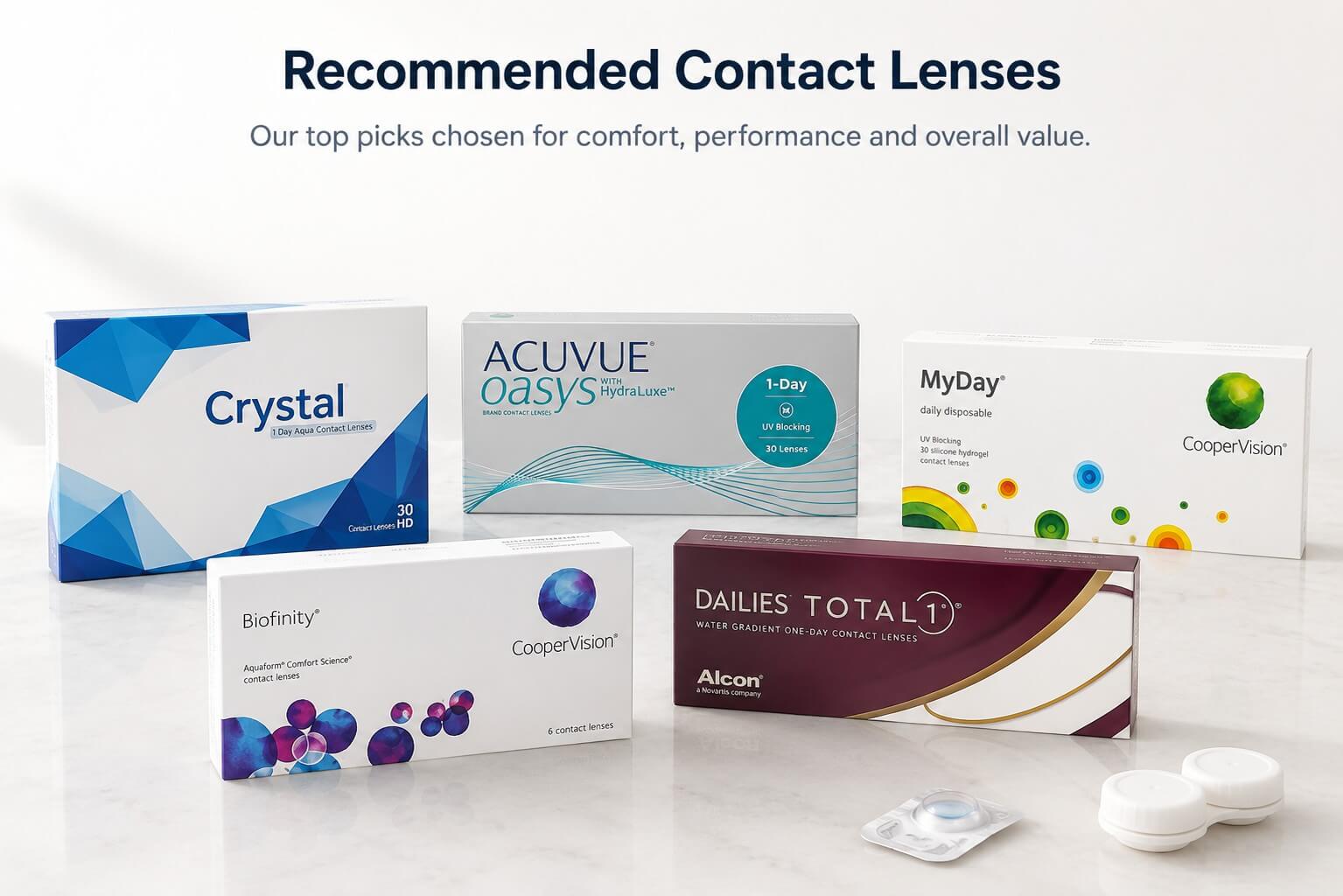
| Best Overall | ACUVUE OASYS 1-Day with HydraLuxe | Daily | Outstanding all-round performance with excellent comfort, breathability and UV protection, making it suitable for a wide range of wearers. |
| Premium Comfort | Dailies Total1 | Daily | Water Gradient Technology creates an exceptionally smooth lens surface for outstanding comfort, particularly during long days of wear. |
| Everyday Comfort | MyDay Daily | Daily | A comfortable silicone hydrogel lens that combines excellent breathability with reliable everyday performance. |
| Best Value | Crystal Aqua Daily | Daily | A dependable daily disposable that offers excellent comfort and quality at an affordable price. |
| Best Monthly | Biofinity | Monthly | A trusted monthly lens offering an excellent balance of comfort, high oxygen transmissibility and overall value. |
Best Daily Contact Lenses
Best for: Wearers who prioritise hygiene, convenience and flexibility, including part-time wearers and those with sensitive eyes.
Daily disposables provide a fresh pair of lenses every day. They remove the need for cleaning solutions, reduce the opportunity for deposits to build up and are especially practical for occasional wear, sport, travel and busy lifestyles.
Many of today’s leading daily lenses use silicone hydrogel materials, which allow considerably more oxygen to reach the eye than traditional hydrogel lenses. However, material alone does not determine comfort: surface technology, fit, prescription and your tear film all matter.
Our Daily Contact Lens Recommendations
| Best For | Contact Lens | Replacement | Why We Chose It |
|---|---|---|---|
| Best Overall Daily | ACUVUE OASYS 1-Day With HydraLuxe | Daily | High oxygen transmission, HydraLuxe Technology and reliable comfort for long or demanding days. |
| Premium Comfort | Dailies Total1 | Daily | A water-gradient surface designed to feel smooth and highly wettable. |
| Everyday Comfort | MyDay Daily | Daily | Naturally wettable silicone hydrogel with strong all-day performance. |
| 🌱 Best for Beginners | 1 Day ACUVUE Moist | Daily | Established comfort, a visibility tint and straightforward handling. |
| Best Value | Crystal Aqua Daily | Daily | Simple, dependable daily wear at an accessible price. |
What to Look for in a Daily Lens
- Comfort for your normal wearing day: a lens that feels good for four hours may not suit a twelve-hour day.
- Suitable oxygen transmission: particularly important for long hours and frequent wear.
- Moisture or surface technology: helpful if you experience dryness or high screen exposure.
- Handling: very thin premium lenses can feel wonderful but may be less forgiving for new wearers.
- Pack size and value: compare the cost per lens rather than the box price alone.
Helpful Guides
Best Monthly Contact Lenses
Best for: Regular wearers who want a lower cost per wearing day and are committed to a consistent cleaning and storage routine.
Monthly contact lenses can offer excellent comfort and value, particularly for people who wear lenses most days. Unlike daily disposables, they must be cleaned and disinfected after every use, stored correctly and replaced according to their prescribed schedule.
Most leading monthly lenses now use silicone hydrogel materials, which allow significantly more oxygen to reach the cornea than older hydrogel designs.
Our Monthly Contact Lens Recommendations
| Best For | Contact Lens | Replacement | Why We Chose It |
|---|---|---|---|
| Best Overall Monthly | Biofinity | Monthly | Aquaform Technology, high oxygen transmission and dependable all-day comfort. |
| ⭐ Premium Surface Technology | TOTAL30 | Monthly | A reusable water-gradient lens designed to maintain a highly wettable surface. |
| 🛡 Best for Deposit Resistance | Air Optix plus HydraGlyde | Monthly | Surface and moisture technologies designed for long days and deposit control. |
| 💧 Best for Sensitive or Dry Eyes | Proclear | Monthly | PC Technology is designed to attract and retain water. |
| Best Value | Crystal Monthly | Monthly | An affordable reusable option for suitable regular wearers. |
Monthly Lens Care Matters
Monthly lenses are only good value when they are cared for correctly. Wash and dry your hands before handling them, use fresh recommended solution, never top up old solution and replace the lens case regularly.
Helpful Guides
Should You Choose Daily or Monthly Contact Lenses?
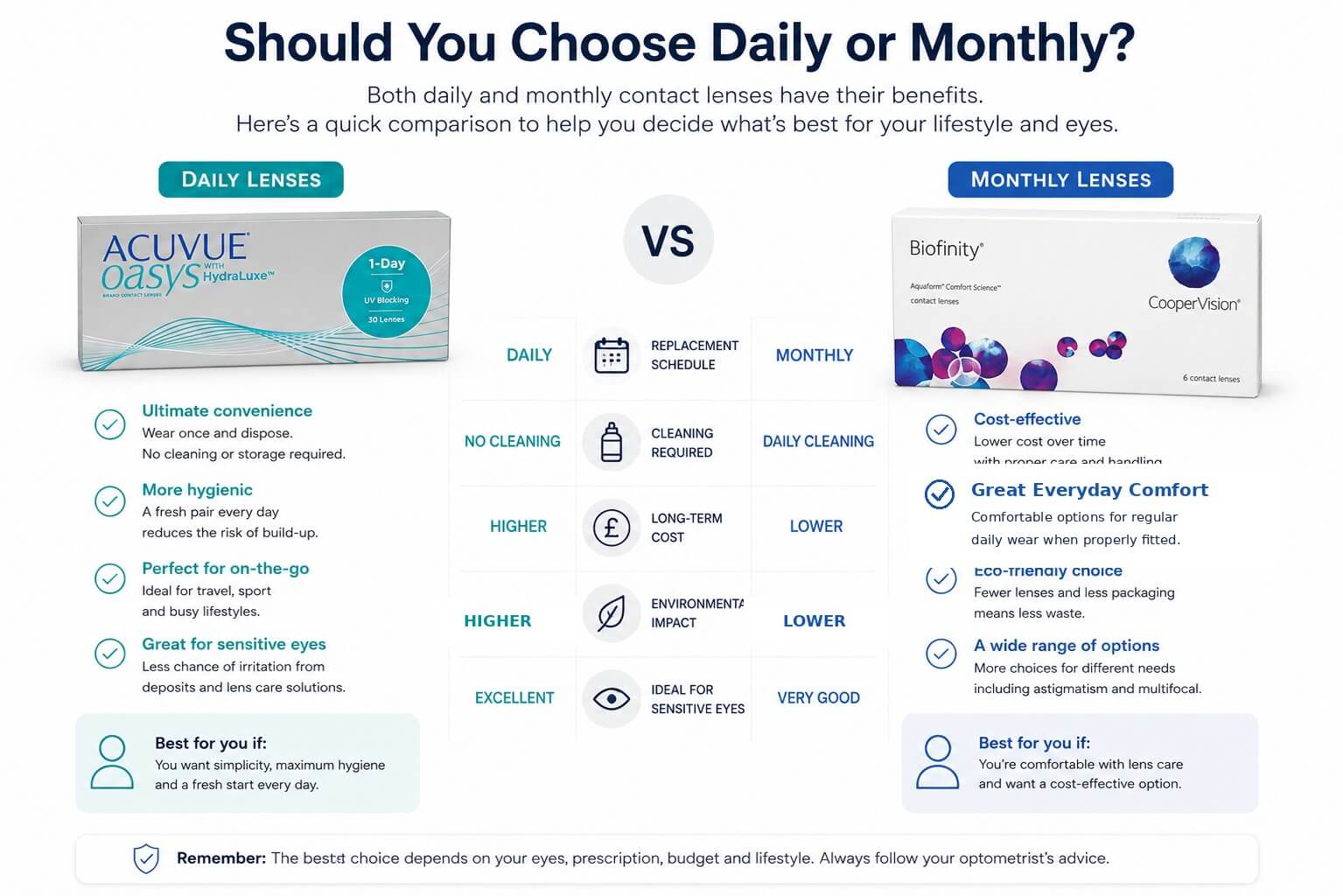
The better option depends on how frequently you wear lenses, your budget, your routine and how much maintenance you are comfortable with.
| Consideration | Daily Disposables | Monthly Lenses |
|---|---|---|
| Hygiene | Fresh lens every day | Require careful cleaning and storage |
| Convenience | No solutions or cases | More daily maintenance |
| Occasional wear | Often the most practical choice | May be wasteful if rarely worn |
| Full-time wear | Simple but usually higher cost per day | Often lower cost per day |
| Travel and sport | Highly convenient | Requires solutions and a case |
Should You Choose Hydrogel or Silicone Hydrogel Contact Lenses?
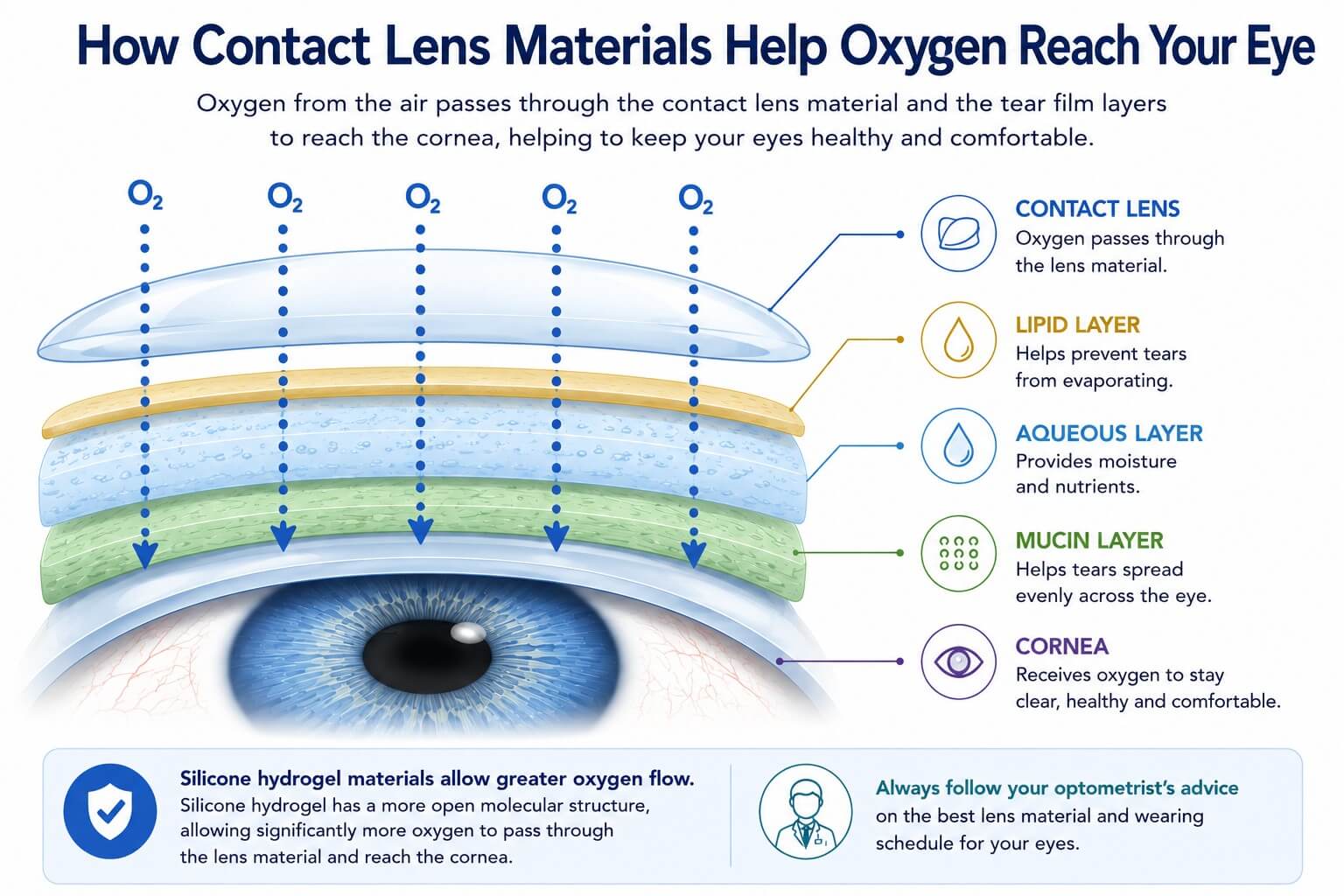
Most soft contact lenses are made from either hydrogel or silicone hydrogel. The main difference is how much oxygen the lens material allows to reach the cornea.
Silicone hydrogel lenses generally allow more oxygen to pass through the lens, which can be beneficial for people who wear contact lenses for long periods. Hydrogel lenses remain a comfortable and reliable option for many everyday and occasional wearers.
The best material depends on your eyes, wearing routine, lifestyle and the recommendation of your optometrist.
| Consideration | Hydrogel Lenses | Silicone Hydrogel Lenses |
|---|---|---|
| Oxygen transmission | Lower oxygen permeability | Higher oxygen permeability |
| Water content | Generally higher | Generally lower |
| Comfort | Great everyday comfort | Great everyday comfort |
| Handling | Usually softer and more flexible | Often slightly firmer and may hold their shape better |
| Best for | Everyday and occasional users | Long daily wear, screen users and active lifestyles |
| Cost | Often more affordable | Often positioned at a premium price |
Why Oxygen Matters
The cornea does not contain blood vessels, so it receives much of its oxygen directly from the air. When a contact lens sits on the surface of the eye, the material affects how easily oxygen can pass through to the cornea.
Allowing sufficient oxygen to reach the eye helps support healthy, comfortable lens wear. This can be particularly important for people who wear their lenses for long periods or spend much of the day in dry, air-conditioned or screen-heavy environments.
Which Material Might Suit You?
Hydrogel lenses may suit you if:
- You want great everyday comfort.
- You wear contact lenses every day or occasionally.
- You prefer a softer, more flexible lens.
- You are looking for a more affordable option.
- Your optometrist finds that a hydrogel lens fits and performs well on your eyes.
Silicone hydrogel lenses may suit you if:
- You wear contact lenses for long periods.
- You spend many hours using digital screens.
- You have an active lifestyle.
- Your optometrist recommends a lens with higher oxygen transmission.
- You prefer a lens that may feel slightly firmer and easier to handle.
Best Contact Lenses for Beginners
Best for: First-time wearers who want a safe, simple starting point with minimal maintenance and an easier learning curve.
Starting contact lenses can feel daunting. Daily disposables remove many of the variables: there is no cleaning routine to master, no storage case and no risk of accidentally stretching one pair beyond its replacement schedule.
The easiest lens to handle is not always the thinnest. A subtle visibility tint and a slightly more substantial feel can make a lens easier to locate, position and remove while confidence develops.
What Makes a Good Beginner Lens?
- Daily replacement with no cleaning or storage routine.
- A visibility tint to make the lens easier to see.
- Predictable handling during insertion and removal.
- Comfortable initial awareness and stable vision.
- A sensible price while the wearer establishes a routine.
| Best For | Contact Lens | Replacement | Why We Chose It |
|---|---|---|---|
| Best Value Beginner Lens | Crystal Aqua Daily | Daily | Good handling, everyday comfort and an accessible trial cost. |
| Proven Choice | 1 Day ACUVUE Moist | Daily | Visibility tint, established comfort and UV protection. |
| Soft Initial Feel | Dailies All Aquacomfort Plus | Daily | High water content and a familiar daily-disposable format. |
Your First Fitting
Your optometrist will check the fit, vision and eye response, then teach you how to insert, remove and care for your lenses safely. That appointment is an essential part of beginning contact lens wear.
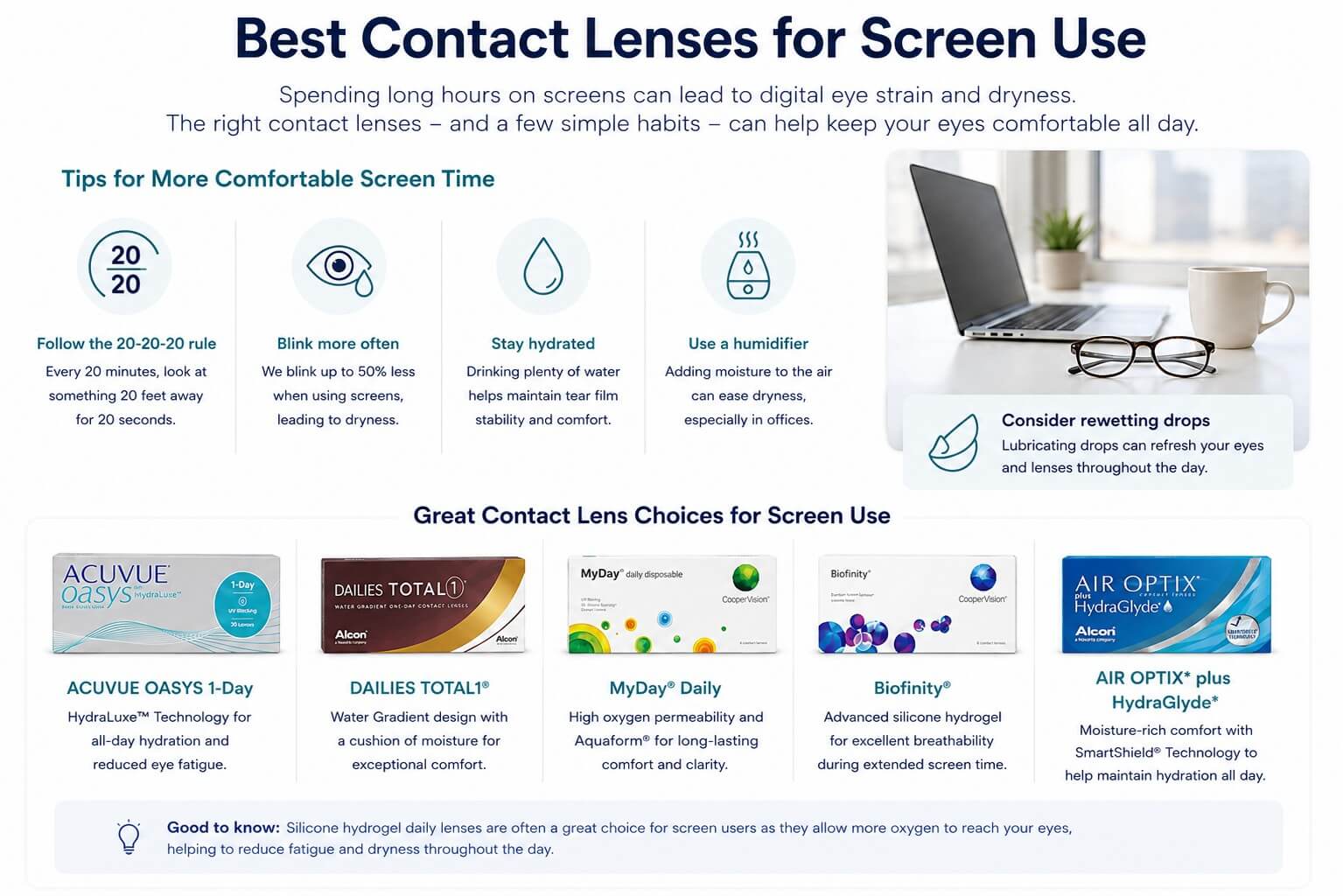
Best Contact Lenses for Screen Use
Best for: Office workers and anyone who spends long periods using computers, tablets or phones and experiences end-of-day dryness or discomfort.
Contact lenses do not become unsuitable simply because you use a screen, but concentrated screen work can make them feel drier. When we focus, we tend to blink less frequently and less completely. That allows the tear film to break up more quickly and moisture to evaporate from the lens surface.
For screen users, the most helpful lenses tend to combine good oxygen transmission with effective surface wettability or moisture technology. Your working environment, screen position, air conditioning and wearing time also influence comfort.
Our Recommendations for Screen Users
| Best For | Contact Lens | Replacement | Why We Chose It |
|---|---|---|---|
| Long Screen Days | ACUVUE OASYS 1-Day With HydraLuxe | Daily | HydraLuxe Technology and high oxygen transmission for demanding wearing days. |
| Premium Comfort | Dailies Total1 | Daily | Water-gradient surface designed to minimise friction. |
| Everyday Office Wear | MyDay Daily | Daily | Naturally wettable silicone hydrogel with reliable comfort. |
| Best Monthly | Biofinity | Monthly | Aquaform Technology and strong breathability for regular wearers. |
| Deposit Resistance | Air Optix plus HydraGlyde | Monthly | Surface technology designed for longer wearing days. |
Helpful Tips for Long Periods of Screen Use
- Use the 20-20-20 Rule: Every 20 minutes, look at something approximately 20 feet away for at least 20 seconds. This gives your focusing system a brief break and encourages you to blink more naturally.
- Position your screen slightly below eye level: This helps reduce the amount of the eye’s surface exposed to the air, slowing tear evaporation.
- Take regular breaks: Do not wait until your eyes feel tired or dry before looking away from your screen.
- Avoid direct airflow: Fans, heaters and air conditioning can increase tear evaporation and contribute to lens discomfort.
- Use contact lens-friendly lubricating drops: If recommended by your optometrist, lubricating eye drops designed for contact lens wear can help maintain comfort throughout the day.
Best Contact Lenses for Dry Eyes
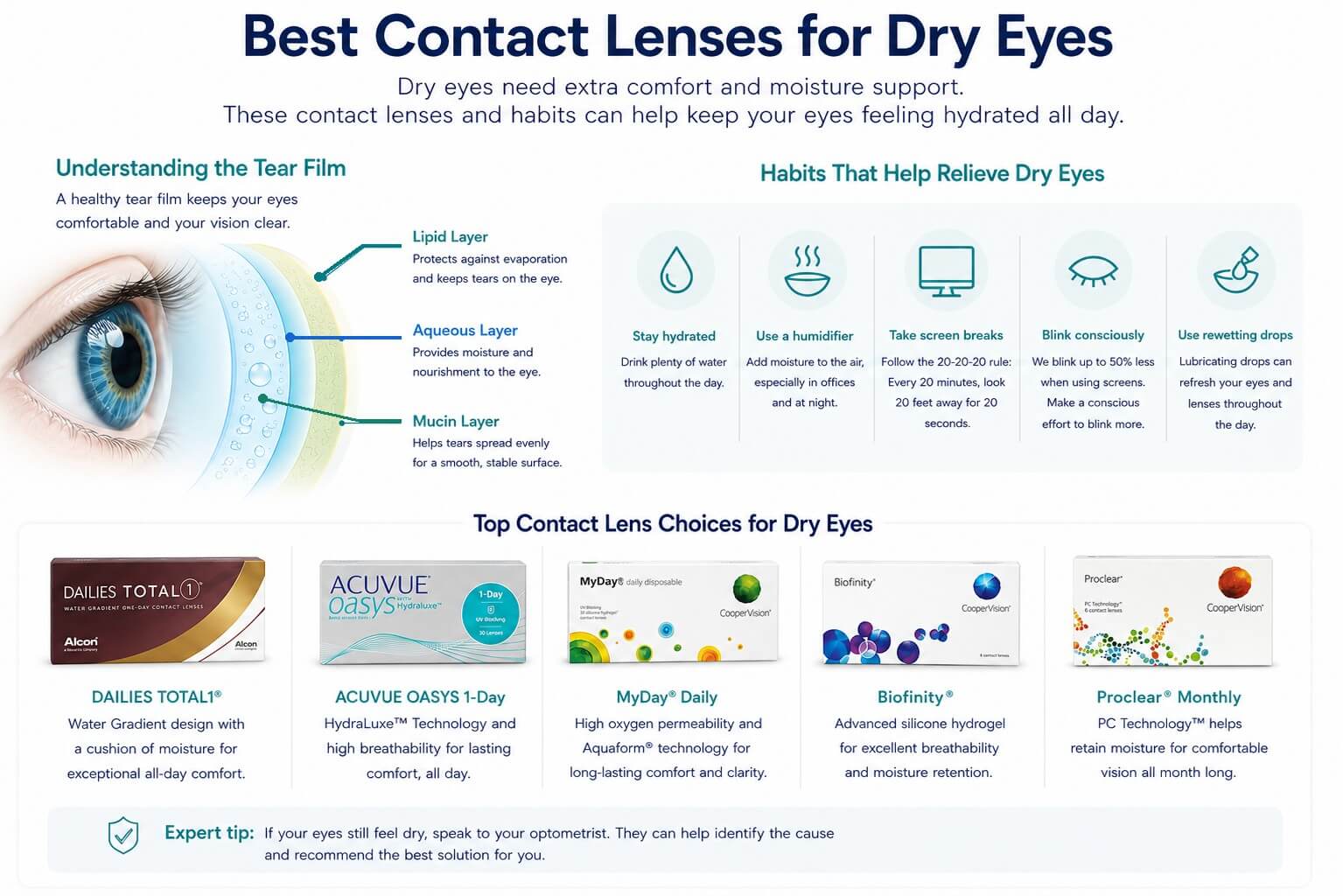
Best for: Wearers who experience dryness, irritation, fluctuating vision or end-of-day discomfort.
Dry eye is one of the most common reasons people reduce or stop contact lens wear. However, the problem is not always contact lenses in general. It may be the lens material, fit, surface behaviour, wearing time, environment or an underlying tear-film problem.
High water content does not automatically mean better comfort for dry eyes. Some high-water hydrogel lenses may lose moisture during wear, while lower-water silicone hydrogel lenses can maintain oxygen transmission without relying on water to carry oxygen through the material.
What to Look for in a Dry-Eye Lens
- Good surface wettability: helps tears spread evenly across the lens.
- Appropriate oxygen transmission: supports corneal health during wear.
- A replacement schedule that suits your tear film: fresh daily lenses may help wearers affected by deposits.
- A fit that allows healthy movement: too tight or too loose can both cause symptoms.
- Technology matched to the cause: not simply the highest water percentage.
Our Recommendations for Dry Eyes
| Best For | Contact Lens | Replacement | Why We Chose It |
|---|---|---|---|
| ⭐ Premium Dry-Eye Comfort | Dailies Total1 | Daily | Water-gradient surface designed for high wettability and low friction. |
| 🏆 Long Days and Screens | ACUVUE OASYS 1-Day with HydraLuxe | Daily | HydraLuxe Technology and high oxygen transmission. |
| Everyday Comfort | MyDay Daily | Daily | Naturally wettable silicone hydrogel material. |
| Best Monthly | Biofinity | Monthly | Aquaform Technology balances breathability and wettability. |
| 💧 Sensitive Eyes | Proclear | Monthly | PC Technology is designed to attract and retain water. |
Can Eye Drops Help?
Lubricating drops may improve comfort, but they should be suitable for use with contact lenses. Preservative-free formulations are often preferred when drops are needed frequently. Persistent symptoms should be assessed rather than repeatedly masked.
Best Contact Lenses for Astigmatism
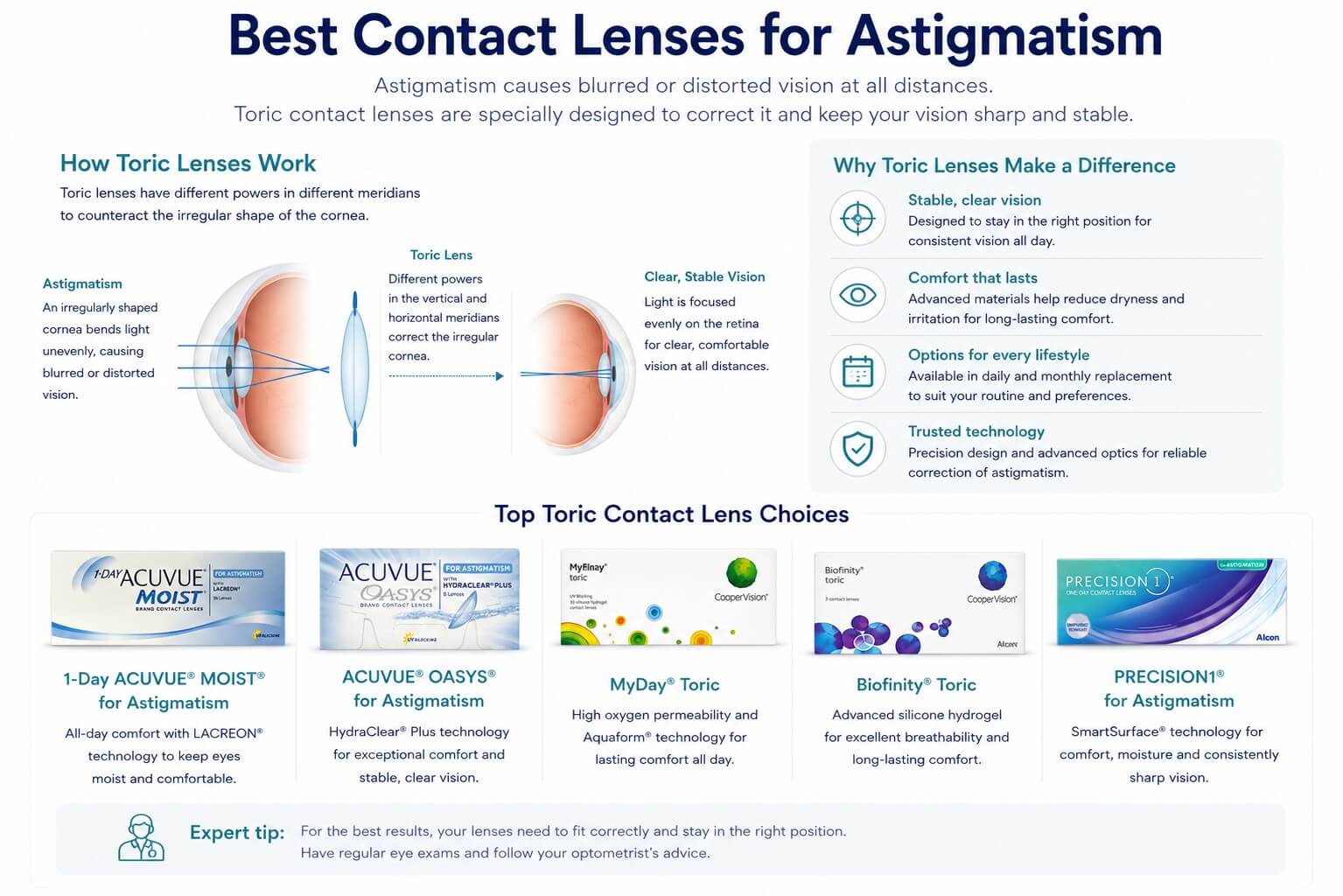
Best for: People whose prescription includes a cylinder and axis correction and who need clear, stable vision.
Astigmatism occurs when the eye’s focusing surface is shaped more like a rugby ball than a perfectly round football. This causes light to focus unevenly. Toric contact lenses contain different powers in different meridians and use a stabilisation design to keep the correction in the right position.
Our Toric Contact Lens Recommendations
| Best For | Contact Lens | Replacement | Why We Chose It |
|---|---|---|---|
| 🌱 Best for Beginners | 1 Day ACUVUE Moist for Astigmatism | Daily | Established toric design with the simplicity of daily replacement. |
| 🏆 Long Hours and Active Wear | ACUVUE OASYS for Astigmatism | Two-weekly | High oxygen transmission and a blink-stabilised design. |
| ⭐ Premium Daily Toric | MyDay Toric | Daily | Breathable material and broad prescription availability. |
| Best Monthly Toric | Biofinity Toric | Monthly | Stable vision, high oxygen transmission and a wide fitting range. |
| 💧 Surface Moisture | PRECISION1 for Astigmatism | Daily | Surface moisture technology combined with toric stability. |
Why Toric Stability Matters
If a toric lens rotates, vision can fluctuate after blinking or during eye movements. A professional fitting assesses how quickly the lens settles, how consistently it remains orientated and whether the vision stays stable throughout normal activities.
Best Multifocal Contact Lenses
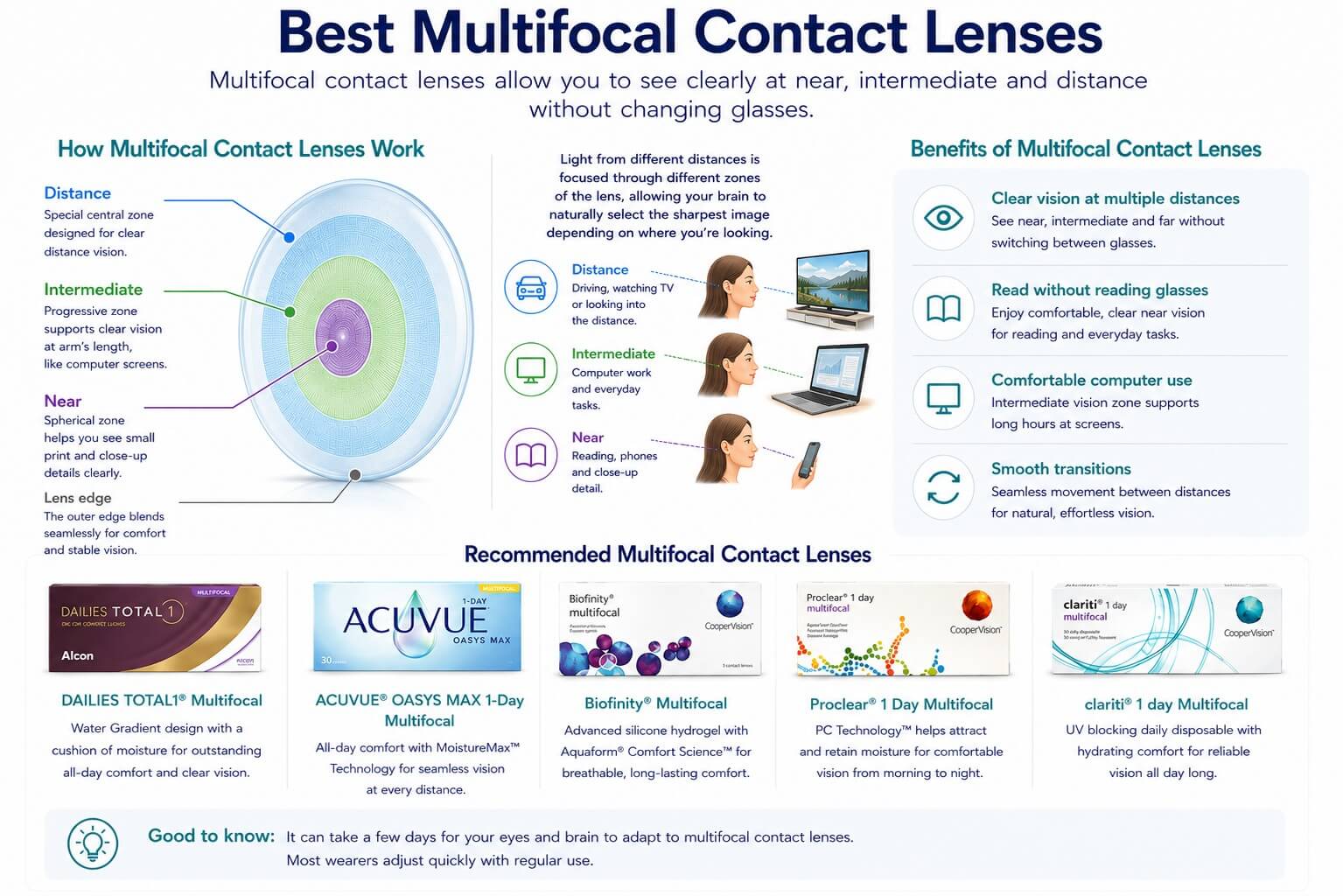
Best for: People with presbyopia who want vision at near, intermediate and distance ranges.
Presbyopia is a natural age-related change in focusing ability. Multifocal lenses use more than one optical zone, allowing the visual system to select the image needed for different distances. Adaptation can take time, and the final prescription may require refinement.
| Best For | Contact Lens | Replacement | Why We Recommend It |
|---|---|---|---|
| Premium daily comfort | Dailies Total1 Multifocal | Daily | Water-gradient surface and daily convenience. |
| Advanced daily option | ACUVUE OASYS MAX 1-Day Multifocal | Daily | Designed for modern visual demands and screen use. |
| Full-time monthly wear | Biofinity Multifocal | Monthly | High oxygen transmission and flexible fitting options. |
| Sensitive eyes | Proclear 1 Day Multifocal | Daily | Hydrogel material with PC Technology. |
| Value monthly option | Air Optix Multifocal Plus Hydraglyde | Monthly | Silicone hydrogel material at an accessible price point. |
Will Multifocal Lenses Be as Sharp as Glasses?
Many wearers achieve excellent functional vision, but some compromise between distance and near clarity is normal. The aim is comfortable, useful vision across everyday tasks rather than perfect sharpness at every distance in every light level.
Best Coloured Contact Lenses
Best for: Wearers who want to enhance or change their eye colour safely.
Coloured lenses are medical devices, whether or not they correct vision. They should be professionally fitted and purchased from a reputable optical retailer. Never share coloured contact lenses or buy them from unregulated sellers.
| Best For | Contact Lens | Replacement | Why We Recommend It |
|---|---|---|---|
| Natural-looking colour change | FreshLook Colorblends | Monthly | Multi-tone design and established colour range. |
| Breathable coloured monthly | Air Optix Colors | Monthly | Silicone hydrogel material and natural-looking colour technology. |
| Occasional wear | FreshLook One-Day | Daily | No cleaning routine and a fresh lens for each occasion. |
Choosing a Colour
Enhancement tints tend to deepen lighter natural eye colours, while opaque designs can create a more noticeable change on both light and dark eyes. The final appearance varies with your natural iris colour, lighting and pupil size.
Best Budget Contact Lenses
Best for: Cost-conscious wearers who want reliable lenses without paying for premium technology they may not need.
Affordable does not mean poor quality. Budget contact lenses from reputable manufacturers must meet the same regulatory requirements as more expensive products. The difference often lies in material technology, prescription range, surface treatments and packaging—not basic safety.
| Best For | Contact Lens | Replacement | Why We Recommend It |
|---|---|---|---|
| Budget daily | Crystal Aqua Daily | Daily | Low-maintenance daily lens with strong everyday value. |
| Budget monthly | Crystal Monthly | Monthly | Low cost per wearing day for suitable regular wearers. |
| Breathable value daily | Clariti 1 Day | Daily | Silicone hydrogel material at a lower price point. |
| Established hydrogel daily | SofLens Daily Disposable | Daily | Simple, affordable option for suitable prescriptions. |
| Value reusable lens | Biomedics 55 | Monthly | Traditional hydrogel option for appropriate wearers. |
Value Is More Than Price
The cheapest contact lens is not always the best value. A lens that becomes uncomfortable, limits your wearing time, or does not match your routine may cost less but work less well for you.
Best Premium Contact Lenses
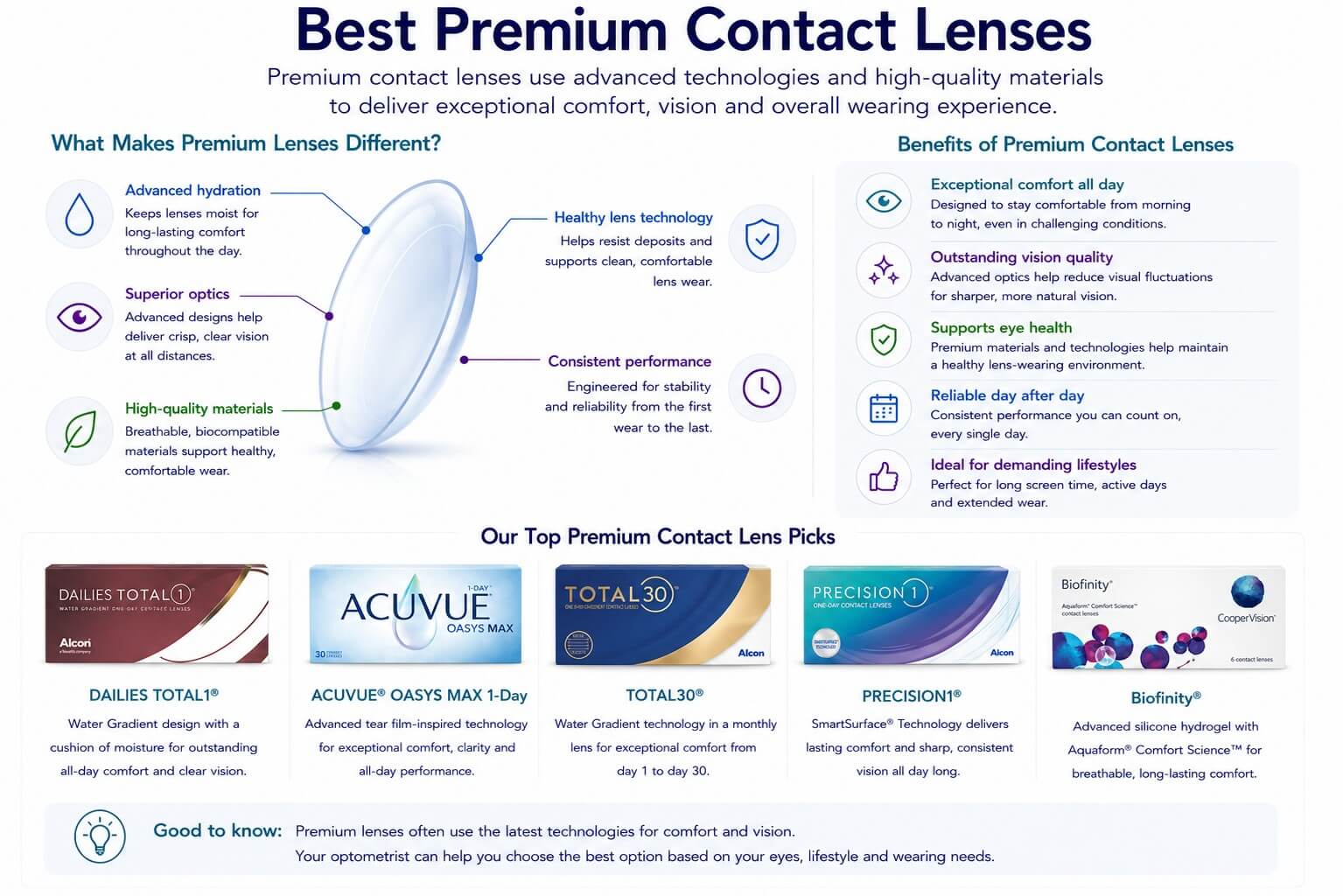
Best for: Wearers who may benefit from advanced materials, moisture technology or specialist design features.
Premium does not automatically mean better. It usually means the lens uses newer materials, surface treatments or optical designs that may improve comfort or performance for particular wearers.
| Best For | Contact Lens | Replacement | Why We Recommend It |
|---|---|---|---|
| Water-gradient comfort | Dailies Total1 | Daily | Highly wettable surface designed for low friction. |
| Long days and screens | ACUVUE OASYS MAX 1-Day | Daily | Advanced comfort and visual technology. |
| Premium monthly daily-wear lens | TOTAL30 | Monthly | Water-gradient reusable lens designed for sustained comfort. |
| Accessible premium daily | PRECISION 1 Daily | Daily | Surface moisture technology at a mid-premium price. |
| Premium monthly value | Biofinity | Monthly | High oxygen transmission and excellent all-round performance. |
Are Premium Lenses Worth It?
They may be worthwhile for people with long wearing days, demanding visual tasks, or a history of discomfort. Occasional wearers with healthy, comfortable eyes may notice less difference.
How to Choose the Right Contact Lenses
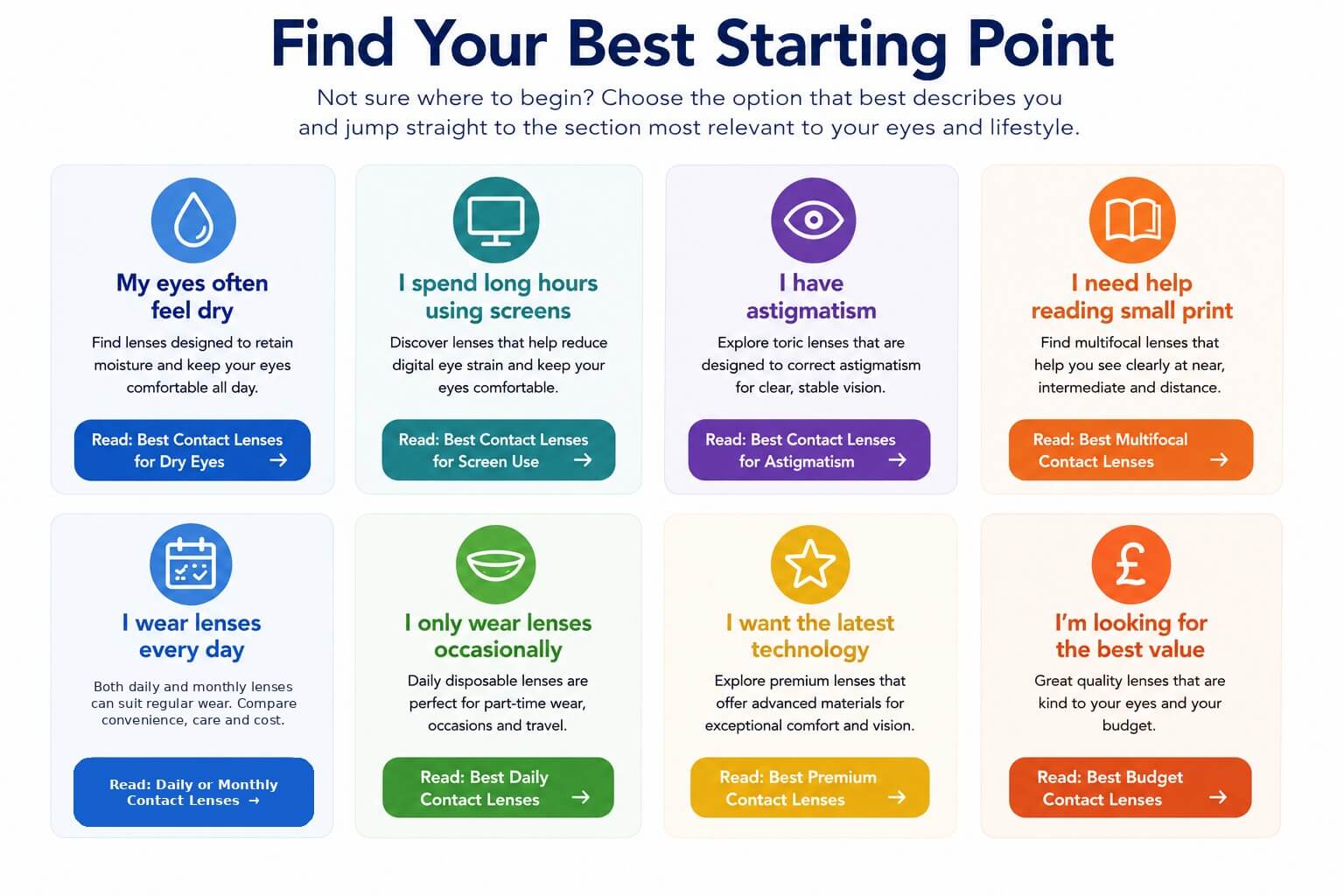
There is no single “best” contact lens. Work through the questions below to identify the type of lens most likely to suit your eyes, routine and priorities.
1. How Often Will You Wear Them?
- Occasionally: Daily disposables are often practical because there is no cleaning routine and unopened lenses are not wasted.
- Most days: Both daily and monthly lenses may work; convenience, comfort and cost become important.
- Every day: Daily lenses remain a strong option, while monthly lenses may reduce the cost per wearing day for people who manage lens care well.
2. Understand the Replacement Schedule
| Schedule | When the Lens Is Replaced | Often Suits |
|---|---|---|
| Daily | After each day of wear | Beginners, occasional wearers, sport, travel and convenience-focused users |
| Weekly | After the specified number of days | Wearers prescribed a specialist weekly lens |
| Two-weekly | Every 14 days | Regular wearers who prefer a reusable lens |
| Monthly | According to the manufacturer’s monthly schedule | Full-time wearers comfortable with cleaning and storage |
| Extended wear | Only as specifically prescribed | Selected wearers under professional supervision |
3. Consider Your Lifestyle
- Office and screen work: Look for stable comfort and effective moisture technology.
- Sport: Daily lenses are often convenient and hygienic.
- Dry environments: Lens surface performance may matter more than water content alone.
- Busy schedules: A low-maintenance routine may be more sustainable.
- Budget: Compare the cost per wearing day, not only the box price.
4. Consider Comfort, Not Just Cost
A lower-priced lens is not good value if it becomes uncomfortable or limits how long you can wear it. Equally, a premium lens is not automatically necessary when an affordable lens already performs well.
5. Follow Your Optometrist’s Recommendation
Lens material, diameter, base curve, movement, tear interaction and prescription availability all affect suitability. Your optometrist can assess factors that no online comparison table can measure.
How We Chose Our Contact Lens Recommendations
Choosing the best contact lenses is not as simple as selecting the newest product or the most recognised brand. Every lens recommended in this guide has been chosen because it performs well in one or more areas that matter to wearers, including comfort, vision, eye health and value.
Our recommendations have been reviewed by John Dreyer BSc (Hons), MCOptom, DipCL, Optometrist & Clinical Content Reviewer, and are based on current contact lens technologies, established clinical principles and the needs of different types of wearers.
What We Considered
- Comfort throughout the day
- Vision quality and stability
- Material and moisture technology
- Eye-health considerations
- Ease of handling
- Prescription availability
- Value for money
- Manufacturer reputation and UK availability
Our Editorial Principles
- Recommendations are based on suitability, not popularity alone.
- Clinical performance is considered alongside comfort, value and practicality.
- We include options for different lifestyles and budgets.
- We explain why a lens has been recommended, not simply what to buy.
- Your optometrist’s recommendation should always take precedence over any buying guide.
Frequently Asked Questions
These concise answers cover questions that apply to most contact lens wearers. More detailed guidance is available in the individual articles across the site.
Can contact lenses get stuck behind your eye?
No. A membrane called the conjunctiva prevents a lens from passing behind the eyeball. A lens can occasionally fold or move under an eyelid, but it cannot disappear behind the eye.
Can I sleep in my contact lenses?
Only if the lenses are specifically approved for extended wear and your optometrist has confirmed that overnight wear is suitable for you. Sleeping in unsuitable lenses increases the risk of infection and other complications.
Can I swim while wearing contact lenses?
It is best to avoid exposing contact lenses to water. If lenses must be worn for swimming, well-fitting goggles and fresh daily disposables are generally the safer approach, with the lenses removed and discarded immediately afterwards.
How many hours a day can I wear contact lenses?
This varies by person and lens type. Follow the wearing schedule recommended by your optometrist rather than assuming the replacement schedule determines the number of hours you can wear them.
What should I do if my contact lenses become uncomfortable?
Remove them promptly. If discomfort, redness or blurred vision continues, do not keep wearing the lenses and seek advice from your optometrist.
Can teenagers wear contact lenses?
Yes. Suitability depends more on maturity, hygiene and the ability to handle lenses responsibly than on a specific age.
Do I still need eye examinations if I wear contact lenses?
Yes. Regular contact lens aftercare appointments allow your optometrist to check your eye health, lens fit and prescription.
Are more expensive contact lenses always better?
No. Premium lenses may use advanced technologies, but the best lens is the one that gives you the right balance of comfort, vision and eye health.
Can I switch to a different brand myself?
Speak to your optometrist first. Lenses with the same power can differ in material, design, fit and performance.
How do I know which contact lenses are right for me?
Your prescription, eye health, tear film, lifestyle and preferences all matter. Use this guide to understand the options, then confirm your choice through a professional fitting.